MIGHTY NINETY
Chapter 8: Reporting for Duty

The original LIFE caption for this photo: "Spearing fish, the islanders go out into the lagoon in outrigger canoes. In canoes like this they often make journeys to other atolls across hundreds of miles of open water."
-Carl Mydans photo in LIFE/Getty Images collection
Tucked into the back pages of the May 7th 1945 issue, LIFE magazine ran a four-page article about the tiny Pacific island of Fassarai. Mostly comprised of photos of island life, the article only contained a few paragraphs of text which read:
LIFE Visits an Enchanted Isle
Americans take Fassarai and find it the romantic kind of South Sea Island they have always dreamed about.
American fighting men who have traveled to the South Pacific in this war have looked in vain for the legendary South Sea islands. Writers like Robert Louis Stevenson and movies like "White Shadows in the South Seas" had prepared them for a happy land of waving palms, warm sand and half-nude girls, a place where life was no work at all. Last fall, when the U.S. took the atoll of Ulithi, 400 miles southwest of Guam, Americans found the closest approach to such a place. On the island of Fassarai in the atoll the palms waved, the sand was warm, and the girls were beautiful. Fassarai was shortly declared off-limits.

LIFE caption: "Casting a net in the surf, one of the Fassarai natives fishes from the beach--exactly as the lithe natives have been doing for years in the romantic travelogs of the Pacific."
-Carl Mydans photo in LIFE/Getty Images collection
The LIFE text continued:
Although the people of Fassarai are bronzed and unspoiled, they have been saddened by their recent history. When the Japanese came after the last war they took the strongest men and the prettiest girls. Now the islanders live by themselves except for two Navy men. The islanders have made one of these men, Dr. Marshall Paul Wees of Saginaw, Mich., their No. 2 king.

Dr. Wees, co-adminstrator of Fassarai with King Ueg, performs a medical checkup of a Ulithian man.
-Carl Mydans photo in LIFE/Getty Images collection

Ulithian children in grass skirts, the one on the right half-Japanese. Ulithian custom was not to dress children until the age of five. The vast lagoon of the atoll lies behind the children.
-Carl Mydans photo in LIFE/Getty Images collection
LIFE's article may have glamorized the island of Fassarai, but it didn't tell the full story of Ulithi Atoll and the U.S. presence there. One significant clue in the article appeared in the caption of a photo showing a short strip of beach with open water beyond that read "Ulithi's calm lagoon, shown at sunset, is large enough to accommodate hundreds of U.S. ships."
Although it would still be several more months before the information would become public, this is exactly how Ulithi Atoll had been utilized since it was seized by U.S. forces in late September 1944. Following the exit of Japanese occupiers, the few remaining native Micronesians had voluntarily relocated to the island of Fassarai under U.S. Navy medical supervision.

A photo from the Carl Mydans LIFE sequence that could not be published in May 1945. Beyond the outrigger canoe lie auxiliary vessels of the United States Pacific Fleet.
-Carl Mydans photo in LIFE/Getty Images collection
Ulithi Atoll was just a speck on maps of the Pacific if it was even present. Officially part of the Caroline Islands, the atoll contained the world's fourth largest lagoon at 209 square miles. In addition to its size, Ulithi was perfectly located as a staging area for the United States against Japan. The Philippines, Formosa, and Okinawa--all of which were targets within U.S. sights--were similar distances from Ulithi.
By October 1944, Ulithi was the hub of U.S. Navy operations in the Western Pacific, a role it would maintain for eight months until the liberated Philippines replaced it as the new forward staging area. At the peak of its usage, during the initial buildup for Okinawa operations in March 1945, Ulithi Atoll was home to 617 American ships.

USS Hancock CV-19 recovering aircraft in October 1944. She was one of at least 16 American aircraft carriers of the Fast Carrier Task Force staging from Ulithi at any given time in late 1944.
-U.S. Navy photo in Brent Jones collection

A USS Essex ordnanceman carries ammunition to the ship's F6F Hellcat fighters, 24 October 1944.
-Paul Madden photo from NARA collection
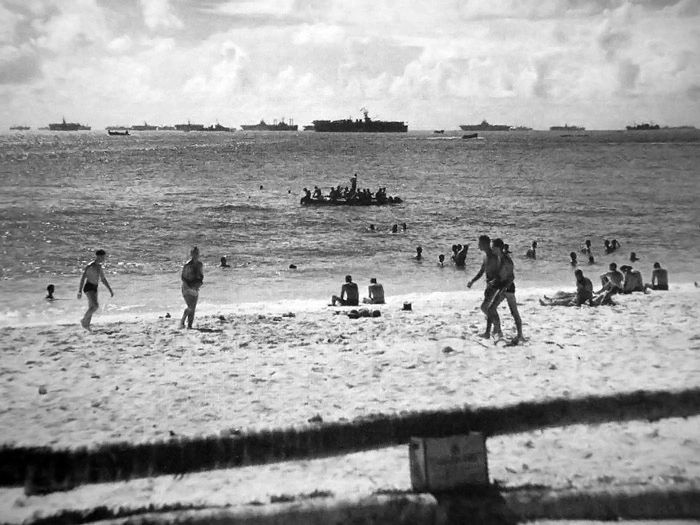
Shipmates from USS Essex CV-9 enjoy liberty at the beach in Ulithi Atoll, December 1944. The aircraft carrier anchorage stretches out behind them.
-Paul Madden photo in Brent Jones collection

Ulithi Atoll, home to the 3rd Fleet in late 1944. The land in the foreground is one of several depot islands surrounding the anchorage. More than 100 ships are visible in this photo.
-U.S. Navy photo from NARA collection

The Japanese were well aware that the U.S. Navy was staging from Ulithi. On the morning of 20 November, five kaiten manned torpedoes entered the atoll. Only one successfully struck a ship, fleet oiler USS Mississinewa AO-59. The oiler burned and capsized before sinking. She is shown here seen from Essex CV-9 at the height of her fires around 0900.
-U.S. Navy photo from NARA collection
26 November 1944
USS Astoria CL-90 entered the lagoon at Ulithi anchorage and reported for duty.
From the Mighty Ninety cruise book:
"Ulithi, our base during the majority of our first cruise, is a small atoll in the Caroline Islands that is ignored on most of the world maps. Contrary to popular belief that it was a tropical paradise, as inspired by LIFE’s glowing article, to us it was merely an anchorage and a rough one at that. We made liberty there, and on occasion to Mog Mog, one of the small islands that formed the atoll. There we could swim among the razor sharp coral and drink our three cans of beer. With no women and very little song it became just a spot of beer cans and coral where we could rest our feet from the steel decks of the ship.

USS Astoria's first view of Ulithi Atoll as she turns from Mugai Channel into the North Anchorage. Fleet carriers are visible in the background.
-photo taken by and courtesy of Herman Schnipper

USS Astoria fuels from Sepulga AO-20 immediately after arriving at Ulithi. USS San Diego CL-53 is anchored at center top.
-photo taken by and courtesy of Herman Schnipper
The ships of the Fast Carrier Task Force also began to arrive, one group at a time, from their support of Leyte operations. In Astoria's newly-assigned unit, Task Group 38.2, three carriers had been hit by suicide planes off Leyte--Hancock, Intrepid, and Cabot. It was becoming clear that Mighty Ninety's role in screening the fast carriers would focus on threats from above.
The crew of Astoria spent the next few days resupplying in anticipation of a pending departure with her task group. The entire anchorage was a hive of activity preparing a quick turnaround: the fast carriers were returning to the Philippines to support landings on the island of Mindoro.

USS Pasadena CL-65, flagship of Cruiser Division 17, in November 1944. Astoria CL-90 became the second cruiser available for duty in CruDiv 17.
-U.S. Navy photo from NARA collection

Ships of Task Group 38.3 perform a synchronized turn during Leyte operations in November 1944. The maneuver permits each ship to maintain relative position while changing direction. This photo gives a good idea of the 1700-yard spacing typical in late-war task group formations. The four closest ships are (left to right): Langley CVL-27, Essex CV-9, Santa Fe CL-60 and Lexington CV-16.
-U.S. Navy photo from NARA collection
1 December 1944
Task Group 38.2 was Astoria's new assignment under the command of Rear Admiral Gerald Bogan. In the cruiser screen, the Mighty Ninety was joined by three other Clevelands: her Cramp-built sister Miami CL-89, Vincennes CL-64, and fellow newcomer Pasadena CL-65, a ship that Astoria would spend her entire career alongside. Rounding out the division was the older cruiser San Juan CL-54--a ship which had fought alongside Astoria CA-34 back at Guadalcanal in 1942.
When Task Groups 38.1 and 38.2 left Ulithi on 1 December, they were originally headed back to the Philippines for further combat operations, not training exercises. But a few hours after the ships put to sea, they learned that General MacArthur had postponed the Mindoro invasion by ten days. This news was well received, as it allowed the weary Task Group 38.3 to retire to Ulithi for rest and upkeep while the other groups conducted training exercises in the surrounding waters.

Above and below: Task Group 38.3 returns to Ulithi in column on 2 December 1944. Front to back are carriers USS Langley and Ticonderoga, battleships Washington BB-56, North Carolina BB-55 and South Dakota BB-57, and cruisers Santa Fe CL-60, Biloxi CL-80, Mobile CL-63, and Oakland CL-95. These photos were taken from Essex CV-9.
-U.S. Navy photos taken by Paul Madden in Brent Jones collection


Task Group 38.3 was the final task group to return to Ulithi following Leyte operations. In this photo the column has executed a simultaneous turn to port. Most visible are Langley CVL-27 and Ticonderoga CV-14, but there are seven more ships behind them in the formation.
-U.S. Navy photo taken by Paul Madden in Brent Jones collection

Astoria's number one OS2N-1 Kingfisher floatplane launches from the port catapult on 4 December 1944 during training exercises. The pilot is Senior Aviator Charles Tanner.
-photo taken by and courtesy of Herman Schnipper

Tanner's Kingfisher taxis toward the ship during "Charlie method" recovery operations off Ulithi on 4 December 1944. Astoria has performed a 270-degree turn to create a "lake" of calmer water for the plane to land upon.
-photo taken by and courtesy of Herman Schnipper

Tanner's plane is hooked onto the recovery sled and he is out of the cockpit, preparing to hook up to the ship's recovery crane.
-photo taken by and courtesy of Herman Schnipper
8 December 1944
Astoria and the ships of Task Group 38.2 returned to Ulithi for final provisioning and preparation. Three days later, USS Astoria CL-90 would steam for the Philippines as part of the greatest display of naval power that the world had ever seen: the Pacific Fleet's Fast Carrier Task Force.
Continue to Chapter 8: OPERATION LOVE III

CLICK ON PHOTOS TO ADVANCE TO NEXT CHAPTER
BACK TO SHIP HISTORY
Sources:
Blodgett, Herbert. "Remembering Typhoon Cobra." U.S. Navy Cruiser Sailors Association Quarterly, Summer 2006, pp. 29-30.
Cote, Larry. Private photo collection.
Morison, Samuel Eliot. History of
United States Naval Operations in WWII Vol. XII:
Leyte.
Boston: Little, Brown and Company Inc., 1958.
Morison, Samuel Eliot. History of
United States Naval Operations in WWII Vol. XIII: The Liberation of the Philippines.
Boston: Little, Brown and Company Inc., 1959.
Schnipper, Herman. Private photo collection.
Unk. editor. MIGHTY NINETY: USS ASTORIA CL-90 cruise book. Unk. publisher, 1946.
www.archives.gov National Archives and Records Administration WWII photo archive.
www.navsource.org cruiser photo archive.

The original LIFE caption for this photo: "Spearing fish, the islanders go out into the lagoon in outrigger canoes. In canoes like this they often make journeys to other atolls across hundreds of miles of open water."
-Carl Mydans photo in LIFE/Getty Images collection
Tucked into the back pages of the May 7th 1945 issue, LIFE magazine ran a four-page article about the tiny Pacific island of Fassarai. Mostly comprised of photos of island life, the article only contained a few paragraphs of text which read:
LIFE Visits an Enchanted Isle
Americans take Fassarai and find it the romantic kind of South Sea Island they have always dreamed about.
American fighting men who have traveled to the South Pacific in this war have looked in vain for the legendary South Sea islands. Writers like Robert Louis Stevenson and movies like "White Shadows in the South Seas" had prepared them for a happy land of waving palms, warm sand and half-nude girls, a place where life was no work at all. Last fall, when the U.S. took the atoll of Ulithi, 400 miles southwest of Guam, Americans found the closest approach to such a place. On the island of Fassarai in the atoll the palms waved, the sand was warm, and the girls were beautiful. Fassarai was shortly declared off-limits.

LIFE caption: "Casting a net in the surf, one of the Fassarai natives fishes from the beach--exactly as the lithe natives have been doing for years in the romantic travelogs of the Pacific."
-Carl Mydans photo in LIFE/Getty Images collection
The LIFE text continued:
Although the people of Fassarai are bronzed and unspoiled, they have been saddened by their recent history. When the Japanese came after the last war they took the strongest men and the prettiest girls. Now the islanders live by themselves except for two Navy men. The islanders have made one of these men, Dr. Marshall Paul Wees of Saginaw, Mich., their No. 2 king.

Dr. Wees, co-adminstrator of Fassarai with King Ueg, performs a medical checkup of a Ulithian man.
-Carl Mydans photo in LIFE/Getty Images collection

Ulithian children in grass skirts, the one on the right half-Japanese. Ulithian custom was not to dress children until the age of five. The vast lagoon of the atoll lies behind the children.
-Carl Mydans photo in LIFE/Getty Images collection
LIFE's article may have glamorized the island of Fassarai, but it didn't tell the full story of Ulithi Atoll and the U.S. presence there. One significant clue in the article appeared in the caption of a photo showing a short strip of beach with open water beyond that read "Ulithi's calm lagoon, shown at sunset, is large enough to accommodate hundreds of U.S. ships."
Although it would still be several more months before the information would become public, this is exactly how Ulithi Atoll had been utilized since it was seized by U.S. forces in late September 1944. Following the exit of Japanese occupiers, the few remaining native Micronesians had voluntarily relocated to the island of Fassarai under U.S. Navy medical supervision.

A photo from the Carl Mydans LIFE sequence that could not be published in May 1945. Beyond the outrigger canoe lie auxiliary vessels of the United States Pacific Fleet.
-Carl Mydans photo in LIFE/Getty Images collection
Ulithi Atoll was just a speck on maps of the Pacific if it was even present. Officially part of the Caroline Islands, the atoll contained the world's fourth largest lagoon at 209 square miles. In addition to its size, Ulithi was perfectly located as a staging area for the United States against Japan. The Philippines, Formosa, and Okinawa--all of which were targets within U.S. sights--were similar distances from Ulithi.
By October 1944, Ulithi was the hub of U.S. Navy operations in the Western Pacific, a role it would maintain for eight months until the liberated Philippines replaced it as the new forward staging area. At the peak of its usage, during the initial buildup for Okinawa operations in March 1945, Ulithi Atoll was home to 617 American ships.

USS Hancock CV-19 recovering aircraft in October 1944. She was one of at least 16 American aircraft carriers of the Fast Carrier Task Force staging from Ulithi at any given time in late 1944.
-U.S. Navy photo in Brent Jones collection

A USS Essex ordnanceman carries ammunition to the ship's F6F Hellcat fighters, 24 October 1944.
-Paul Madden photo from NARA collection

Shipmates from USS Essex CV-9 enjoy liberty at the beach in Ulithi Atoll, December 1944. The aircraft carrier anchorage stretches out behind them.
-Paul Madden photo in Brent Jones collection

Ulithi Atoll, home to the 3rd Fleet in late 1944. The land in the foreground is one of several depot islands surrounding the anchorage. More than 100 ships are visible in this photo.
-U.S. Navy photo from NARA collection

The Japanese were well aware that the U.S. Navy was staging from Ulithi. On the morning of 20 November, five kaiten manned torpedoes entered the atoll. Only one successfully struck a ship, fleet oiler USS Mississinewa AO-59. The oiler burned and capsized before sinking. She is shown here seen from Essex CV-9 at the height of her fires around 0900.
-U.S. Navy photo from NARA collection
26 November 1944
USS Astoria CL-90 entered the lagoon at Ulithi anchorage and reported for duty.
From the Mighty Ninety cruise book:
"Ulithi, our base during the majority of our first cruise, is a small atoll in the Caroline Islands that is ignored on most of the world maps. Contrary to popular belief that it was a tropical paradise, as inspired by LIFE’s glowing article, to us it was merely an anchorage and a rough one at that. We made liberty there, and on occasion to Mog Mog, one of the small islands that formed the atoll. There we could swim among the razor sharp coral and drink our three cans of beer. With no women and very little song it became just a spot of beer cans and coral where we could rest our feet from the steel decks of the ship.

USS Astoria's first view of Ulithi Atoll as she turns from Mugai Channel into the North Anchorage. Fleet carriers are visible in the background.
-photo taken by and courtesy of Herman Schnipper

USS Astoria fuels from Sepulga AO-20 immediately after arriving at Ulithi. USS San Diego CL-53 is anchored at center top.
-photo taken by and courtesy of Herman Schnipper
The ships of the Fast Carrier Task Force also began to arrive, one group at a time, from their support of Leyte operations. In Astoria's newly-assigned unit, Task Group 38.2, three carriers had been hit by suicide planes off Leyte--Hancock, Intrepid, and Cabot. It was becoming clear that Mighty Ninety's role in screening the fast carriers would focus on threats from above.
The crew of Astoria spent the next few days resupplying in anticipation of a pending departure with her task group. The entire anchorage was a hive of activity preparing a quick turnaround: the fast carriers were returning to the Philippines to support landings on the island of Mindoro.

USS Pasadena CL-65, flagship of Cruiser Division 17, in November 1944. Astoria CL-90 became the second cruiser available for duty in CruDiv 17.
-U.S. Navy photo from NARA collection

Ships of Task Group 38.3 perform a synchronized turn during Leyte operations in November 1944. The maneuver permits each ship to maintain relative position while changing direction. This photo gives a good idea of the 1700-yard spacing typical in late-war task group formations. The four closest ships are (left to right): Langley CVL-27, Essex CV-9, Santa Fe CL-60 and Lexington CV-16.
-U.S. Navy photo from NARA collection
1 December 1944
Task Group 38.2 was Astoria's new assignment under the command of Rear Admiral Gerald Bogan. In the cruiser screen, the Mighty Ninety was joined by three other Clevelands: her Cramp-built sister Miami CL-89, Vincennes CL-64, and fellow newcomer Pasadena CL-65, a ship that Astoria would spend her entire career alongside. Rounding out the division was the older cruiser San Juan CL-54--a ship which had fought alongside Astoria CA-34 back at Guadalcanal in 1942.
When Task Groups 38.1 and 38.2 left Ulithi on 1 December, they were originally headed back to the Philippines for further combat operations, not training exercises. But a few hours after the ships put to sea, they learned that General MacArthur had postponed the Mindoro invasion by ten days. This news was well received, as it allowed the weary Task Group 38.3 to retire to Ulithi for rest and upkeep while the other groups conducted training exercises in the surrounding waters.

Above and below: Task Group 38.3 returns to Ulithi in column on 2 December 1944. Front to back are carriers USS Langley and Ticonderoga, battleships Washington BB-56, North Carolina BB-55 and South Dakota BB-57, and cruisers Santa Fe CL-60, Biloxi CL-80, Mobile CL-63, and Oakland CL-95. These photos were taken from Essex CV-9.
-U.S. Navy photos taken by Paul Madden in Brent Jones collection


Task Group 38.3 was the final task group to return to Ulithi following Leyte operations. In this photo the column has executed a simultaneous turn to port. Most visible are Langley CVL-27 and Ticonderoga CV-14, but there are seven more ships behind them in the formation.
-U.S. Navy photo taken by Paul Madden in Brent Jones collection

Astoria's number one OS2N-1 Kingfisher floatplane launches from the port catapult on 4 December 1944 during training exercises. The pilot is Senior Aviator Charles Tanner.
-photo taken by and courtesy of Herman Schnipper

Tanner's Kingfisher taxis toward the ship during "Charlie method" recovery operations off Ulithi on 4 December 1944. Astoria has performed a 270-degree turn to create a "lake" of calmer water for the plane to land upon.
-photo taken by and courtesy of Herman Schnipper

Tanner's plane is hooked onto the recovery sled and he is out of the cockpit, preparing to hook up to the ship's recovery crane.
-photo taken by and courtesy of Herman Schnipper
8 December 1944
Astoria and the ships of Task Group 38.2 returned to Ulithi for final provisioning and preparation. Three days later, USS Astoria CL-90 would steam for the Philippines as part of the greatest display of naval power that the world had ever seen: the Pacific Fleet's Fast Carrier Task Force.
Continue to Chapter 8: OPERATION LOVE III

CLICK ON PHOTOS TO ADVANCE TO NEXT CHAPTER
BACK TO SHIP HISTORY
Sources:
Blodgett, Herbert. "Remembering Typhoon Cobra." U.S. Navy Cruiser Sailors Association Quarterly, Summer 2006, pp. 29-30.
Cote, Larry. Private photo collection.
Morison, Samuel Eliot. History of
Morison, Samuel Eliot. History of
Schnipper, Herman. Private photo collection.
Unk. editor. MIGHTY NINETY: USS ASTORIA CL-90 cruise book. Unk. publisher, 1946.
www.archives.gov National Archives and Records Administration WWII photo archive.
www.navsource.org cruiser photo archive.
